
Wire gauge determines how much current a wire can safely carry. Using the wrong gauge — especially wire that’s too thin for the circuit — is a fire hazard. Here’s a clear guide to understanding wire gauges and matching them to your electrical circuits.
⚡ Key Takeaways
- Wire gauge is measured in AWG (American Wire Gauge) — lower numbers mean thicker wire
- 14 AWG is the minimum for 15A circuits; 12 AWG for 20A circuits
- Never use a wire thinner than what the circuit’s breaker requires — this is a fire hazard
- 240V high-draw circuits (dryers, ranges, EV chargers) require heavier gauge wire: 10, 8, or 6 AWG
- Color coding on cable jackets: white = 14 AWG, yellow = 12 AWG, orange = 10 AWG
What Is AWG (American Wire Gauge)?
AWG stands for American Wire Gauge — the standard system for measuring wire diameter in North America. Counterintuitively, lower AWG numbers indicate thicker wire: 6 AWG wire is much thicker than 14 AWG wire. Thicker wire can carry more current without overheating.
The most important rule: the wire gauge must match or exceed (be equal to or thicker than) what the circuit breaker requires. The breaker’s job is to protect the wire — if the wire is too thin, it overheats before the breaker trips.
Common Residential Wire Gauges
14 AWG — 15-Amp Circuits
The thinnest wire commonly used for branch circuits. Used for general lighting and outlet circuits protected by 15A breakers. Cable jacket color: white. Never use on a 20A circuit.
12 AWG — 20-Amp Circuits
Standard for kitchen countertop outlets, bathroom outlets, garage outlets, and other 20A circuits. Cable jacket color: yellow. Can be used on 15A circuits (acceptable to use heavier wire on a lighter circuit).
10 AWG — 30-Amp Circuits
Required for 30A 240V circuits such as clothes dryers, water heaters, and some air conditioners. Cable jacket color: orange.
8 AWG — 40-Amp Circuits
Used for 40A 240V circuits, including some electric ranges and HVAC equipment. No standard color-coded jacket for 8 AWG residential cable.
6 AWG — 50-Amp Circuits
Required for 50A circuits — standard for electric ranges, NEMA 14-50 EV charging outlets, and large subpanel feeds. This wire is noticeably stiff and difficult to work with compared to smaller gauges.
4 AWG and Larger — Heavy Feeders
Used for 100A+ subpanel feeds and service entrance conductors. Often aluminum for cost savings in these larger gauge applications.
Wire vs. Cable: What’s the Difference?
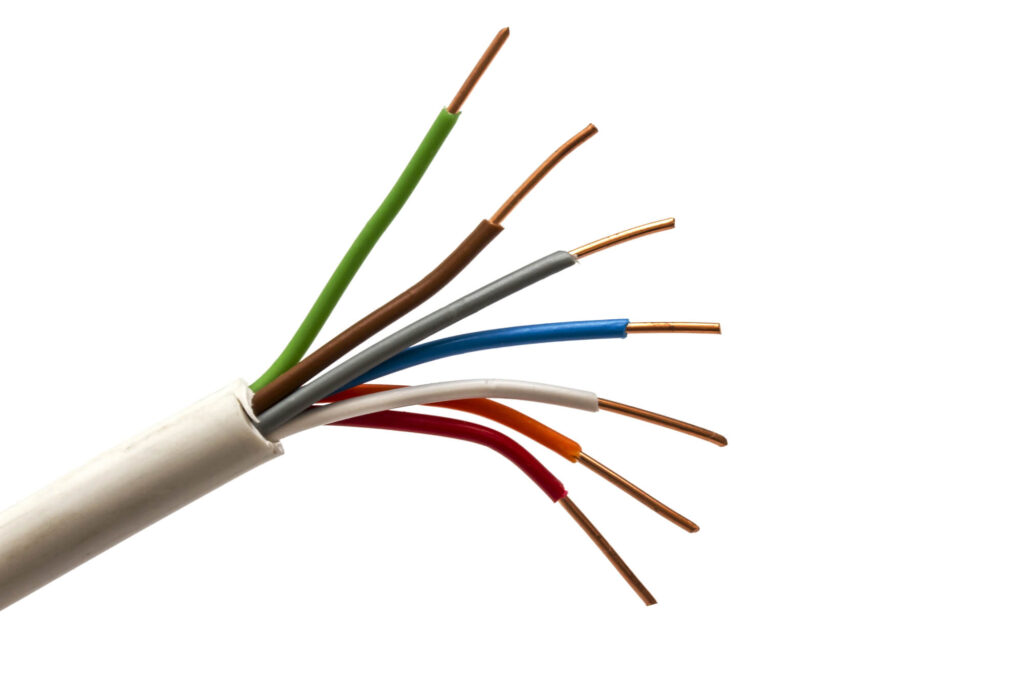
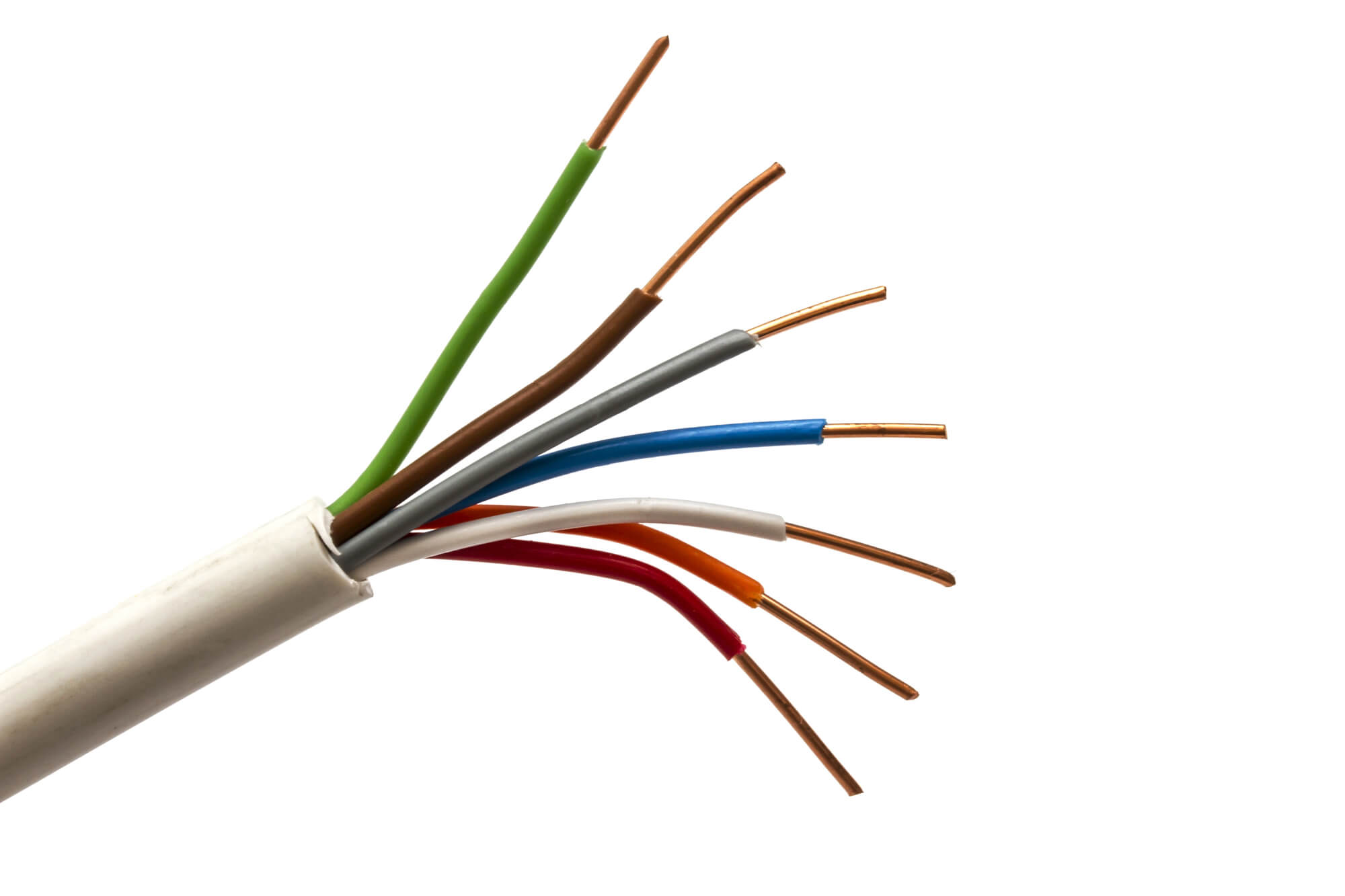
A wire is a single conductor. A cable bundles multiple wires together in a protective jacket. Residential NM (non-metallic sheathed) cable, commonly called “Romex” (a brand name), packages the hot, neutral, and ground wires together in a color-coded jacket — making it easy to run multiple conductors at once through walls and ceilings.
Aluminum vs. Copper Wire
Copper is the standard for branch circuits (outlets, switches, lights) because it’s more conductive, doesn’t oxidize as quickly at connection points, and is more forgiving of improper connections. Aluminum wire is used for service entrance conductors and large feeder cables because it’s less expensive for large gauge applications — but it requires special installation practices (anti-oxidant compound, AL-rated connectors) to be safe.
Never mix aluminum and copper at a connection without using connectors specifically rated for both metals (AL/CU rated).
Choosing the Right Wire Gauge
The circuit breaker determines the required wire gauge. Match wire gauge to breaker:
- 15A breaker → 14 AWG or heavier
- 20A breaker → 12 AWG or heavier
- 30A breaker → 10 AWG or heavier
- 40A breaker → 8 AWG or heavier
- 50A breaker → 6 AWG or heavier
For very long runs (over 100 feet), you may need to upsize the wire one gauge to compensate for voltage drop — your electrician will calculate this for your specific installation.
Wire Gauge for Common Home Circuits: Quick Reference
The relationship between wire gauge and circuit amperage is governed by NEC Article 310, which sets ampacity tables for different wire types and conditions. The most common pairings in residential homes are: 14 AWG wire protected by a 15-amp breaker (used for lighting circuits, general-purpose outlets), 12 AWG wire protected by a 20-amp breaker (used for kitchen countertop outlets, bathroom outlets), 10 AWG wire protected by a 30-amp breaker (dryers, electric water heaters), 6 AWG wire protected by a 50-amp breaker (electric ranges, EV chargers), and 4 AWG wire protected by a 60-amp breaker (large subpanels, multiple large appliances).
These pairings exist because wire size and breaker size are matched to prevent overheating. A 15-amp breaker is designed to trip before 14 AWG wire reaches unsafe temperatures. If you use 14 AWG wire with a 20-amp breaker, the wire will overheat before the breaker trips, creating a fire risk. Conversely, using oversized wire (e.g., 12 AWG for a 15-amp circuit) is permitted by code but is wasteful and unnecessary. Every electrician’s training emphasizes this pairing: use the correct gauge for the breaker rating, no exceptions.
This is not a gray area or a matter of opinion—using the wrong gauge is an explicit code violation and a serious fire hazard. When a home inspector or electrician finds mismatched wire and breaker, they will flag it as an immediate safety issue requiring correction. If you’re doing any electrical work, consult the NEC tables or ask a licensed electrician; the cost of certainty is far less than the cost of a fire or injury.
Frequently Asked Questions
What wire gauge do I need for a 20-amp circuit?
A 20-amp circuit requires a minimum of 12 AWG wire. Using 14 AWG wire on a 20A circuit is a code violation and a fire hazard — the wire would overheat before the breaker trips. Always match wire gauge to the circuit’s breaker rating.
What does AWG mean?
AWG stands for American Wire Gauge, the standard system for measuring wire diameter in the United States. Lower AWG numbers indicate thicker wire — 6 AWG is much thicker and can carry more current than 14 AWG wire.
What wire gauge is needed for an electric dryer?
An electric dryer typically requires a 30A, 240V circuit using 10 AWG wire. Confirm your dryer’s specifications — some larger or older models may require a 40A circuit with 8 AWG wire. Your electrician will verify the correct gauge for your specific appliance.
How can I tell what gauge wire I have?
NM cable (Romex) has the gauge printed on the outer jacket — for example, “12/2 WG” means 12 AWG, 2 conductors plus ground. The jacket color also indicates gauge: white = 14 AWG, yellow = 12 AWG, orange = 10 AWG. A licensed electrician can identify wire gauges during an inspection.
Can I use a larger wire gauge than required?
Yes — using heavier wire than the minimum for a circuit is always acceptable and can be beneficial for long runs. You cannot, however, use a larger breaker than the wire’s rated capacity — the breaker must match or be smaller than what the wire can safely carry.