
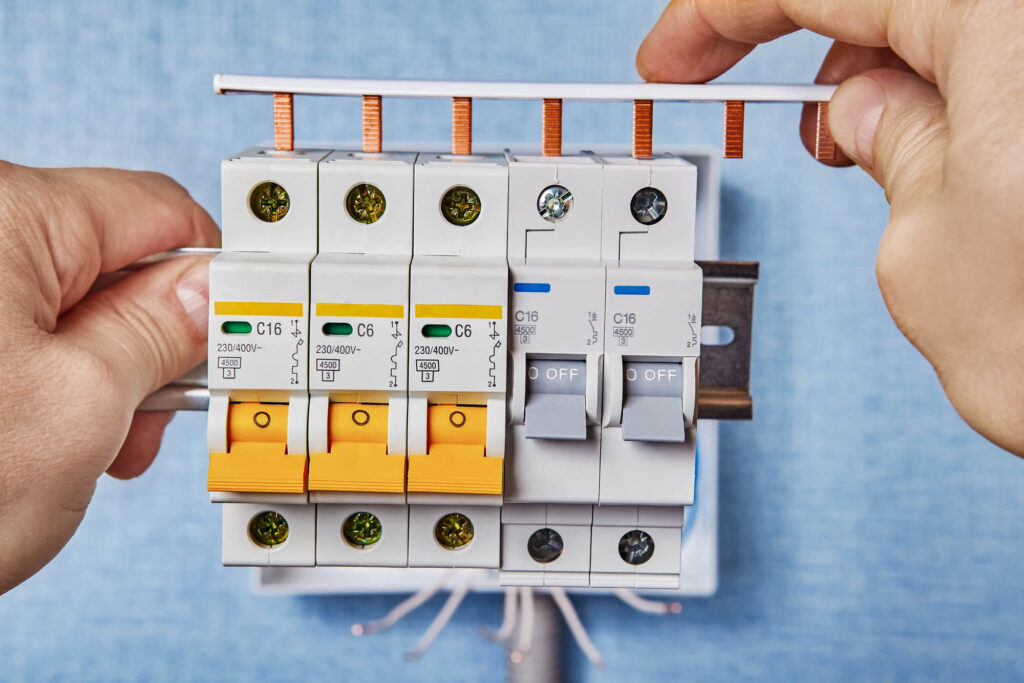
Arc Fault Circuit Interrupter (AFCI) breakers are a modern safety device designed to detect and stop electrical arcing — a leading cause of house fires. If you’ve noticed breakers with “AFCI” or “AFCi” printed on them in your panel, or outlets with TEST and RESET buttons, this guide explains how they work and why they matter.
⚡ Key Takeaways
- AFCI breakers detect electrical arcing and trip before a fire can start.
- AFCI protection is now required by electrical code in US homes for all bedrooms and living areas.
- If an AFCI breaker trips repeatedly, damaged wiring is likely — have an electrician investigate.
What Is Electrical Arcing?
Electrical arcing occurs when current jumps across a gap in damaged wiring, creating a spark or visible arc. This generates extremely high heat — hot enough to ignite wood, insulation, or other materials. Common causes of arcing include damaged wire insulation (from age, rodents, or mechanical damage), loose connections, or undersized wire.
How AFCI Breakers Work
An AFCI breaker monitors the current flowing through the circuit, looking for the characteristic waveform pattern of an arcing fault. When arcing is detected, the breaker trips in milliseconds — before the arc can generate enough heat to ignite surrounding material. This is fundamentally different from a standard breaker, which only responds to overload or short circuit current.
Types of AFCI Protection
Breaker-Type AFCI
Installed at the breaker panel, this single device protects all outlets on the circuit. It’s convenient and effective but doesn’t provide outlet-level protection if the arcing is downstream of the breaker.
Outlet-Type AFCI (Receptacle)
These are special outlets with TEST and RESET buttons that provide local arc fault protection. Outlets downstream of an AFCI outlet are also protected (fed by the outlet).
Combination Protection
Many modern installations use both breaker-level and outlet-level AFCI protection for maximum safety, though this is not always required by code.

Where AFCI Protection Is Required
US electrical code (NEC) now requires AFCI protection in virtually all living areas:
- Bedroom circuits (since 1999)
- Kitchen and dining room circuits (since 2008)
- Living rooms, family rooms, laundry rooms, and hallways (since 2008)
- Bathrooms and outdoor circuits (GFCI is typically used instead, though dual AFCI/GFCI is common)
Requirements vary by region and have been gradually expanded over time. Older homes may not have comprehensive AFCI coverage.
What If an AFCI Breaker Keeps Tripping?
AFCI breakers are sensitive and sometimes trip on false positives — particularly with certain older appliances or device types. However, repeated tripping is a warning sign that should not be ignored. Possible causes include:
- Damaged wiring insulation (the primary concern)
- Failing appliance or motor with internal arcing
- Loose connections creating micro-arcs
- Incompatibility with certain device types (rare)
If an AFCI trips frequently, have an electrician trace and test the circuit. Do not disable or remove the AFCI without professional investigation.
The Science Behind Arc Faults
An arc fault occurs when electricity jumps across a gap between conductors. This can happen when wiring insulation is damaged, wires are loose at connections, or cables are pinched by nails or staples. The electrical arc generates intense heat — temperatures can reach 35,000°F at the arc itself, far beyond the ignition temperature of wood or insulation material. Unlike a short circuit, which causes an immediate large current surge, arc faults often produce repeated low-energy arcs that don’t trip a standard breaker but still generate enough heat over time to start a fire inside a wall.
AFCI vs. GFCI: What’s the Difference?
These are often confused because both are safety devices that trip when they detect a specific electrical fault.
- AFCI (Arc Fault Circuit Interrupter): Detects dangerous electrical arcing in the wiring and disconnects the circuit. Protects against fire. Required in bedrooms, living areas, and most of the home by modern NEC code.
- GFCI (Ground Fault Circuit Interrupter): Detects current flowing outside its intended path — such as current passing through a person. Protects against electric shock. Required in wet locations: bathrooms, kitchens, garages, outdoor areas.
Some locations now require dual-function AFCI/GFCI breakers that provide both protections simultaneously.
Where AFCI Breakers Are Required
The NEC has expanded AFCI requirements over successive code cycles. As of the 2020 NEC, AFCI protection is required for virtually all 15A and 20A 120V branch circuits in new construction — including bedrooms, living areas, dining rooms, kitchens, hallways, closets, and garages. Older homes that haven’t been rewired may not have AFCI protection — upgrades are strongly recommended.
Cost to Upgrade to AFCI Breakers
AFCI breakers cost $25–$55 each (compared to $5–$15 for standard breakers). Including professional installation, expect to pay $50–$150 per breaker. A full home upgrade to AFCI protection might cost $500–$1,500 depending on the number of circuits. Given that AFCI technology prevents many of the most destructive home electrical fires, this investment is highly worthwhile, particularly in older homes with aging wiring.
AFCI vs. GFCI Protection
AFCI and GFCI breakers serve different but complementary safety purposes and are often confused. A GFCI (ground fault circuit interrupter) detects when electricity escapes the normal circuit path and leaks to ground—this happens when you touch a wet appliance or damaged cord, and GFCI shuts off power in milliseconds to prevent electrocution. GFCI protection is required in bathrooms, kitchens, garages, and outdoor outlets. An AFCI (arc fault circuit interrupter) detects the dangerous heat signature of arcing and cuts power to prevent fires. The National Electrical Code now requires AFCI protection on almost all 15- and 20-amp circuits in homes. Many modern breaker panels incorporate dual-function breakers that provide both AFCI and GFCI protection on a single breaker. If your home was built before 2000, your breaker panel likely has neither protection—installing dual-function breakers is an excellent upgrade that costs $100–$300 per breaker and can be done during a routine electrical inspection.
AFCI Nuisance Tripping and Solutions
A drawback of AFCI breakers is occasional nuisance tripping—the breaker cuts power when it detects an arc that’s actually harmless or is triggered by high inrush current from certain appliances. Older appliances, especially corded power tools, sometimes create false alarms. If your AFCI trips when you plug in a specific device, first check that the cord has no visible damage. If the cord is intact, the device’s motor may be creating harmless arcing during startup. Try plugging it into an outlet on a non-AFCI circuit to confirm it works. If you must use the device on an AFCI circuit, contact the manufacturer to see if they offer a compatible adapter or replacement cord. As a last resort, consult an electrician about potentially installing a dedicated circuit without AFCI for that particular appliance, though code compliance may require AFCI protection anyway depending on your jurisdiction.
Frequently Asked Questions
Can I replace a standard breaker with an AFCI breaker myself?
This is not recommended for most homeowners. Breaker replacement requires opening the panel and working around live bus bars. Hire a qualified electrician.
Why does my AFCI outlet keep tripping?
AFCI outlets are sensitive and may trip if a device with poor grounding or internal arcing potential is plugged in. Try unplugging devices one by one to identify the culprit. If the breaker trips with nothing plugged in, there is wiring damage.
Are AFCI breakers more expensive than standard breakers?
Yes, AFCI breakers cost 2–3 times more than standard breakers. However, they provide invaluable fire protection — a worthwhile investment.