
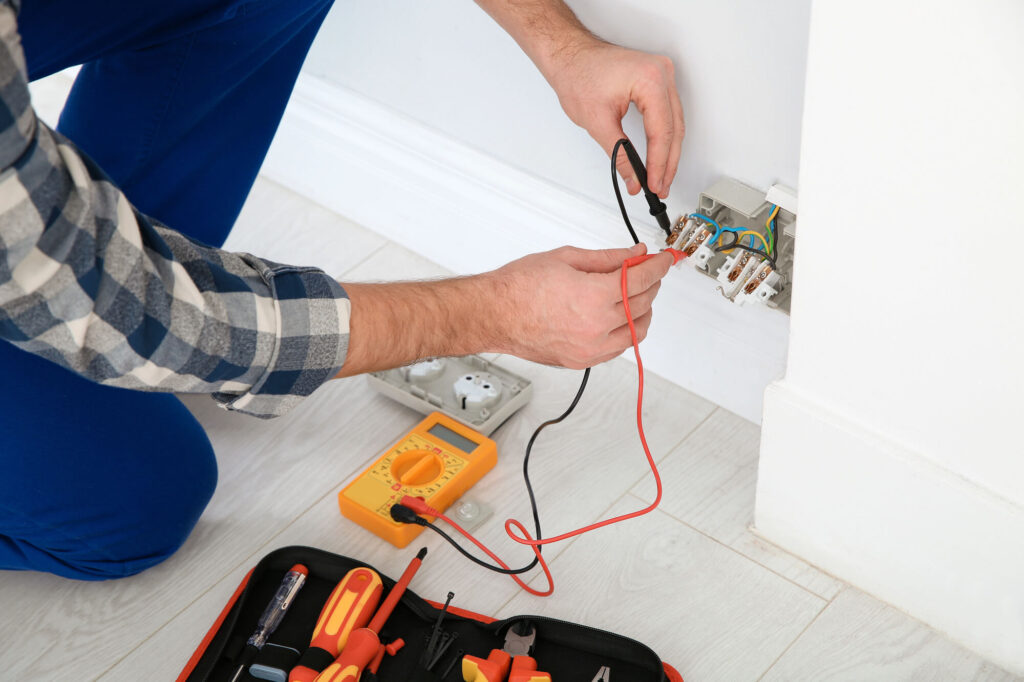
If you find yourself relying on extension cords or power strips, adding an outlet is the safe and proper solution. This guide explains what the process involves, how long it takes, and how much it costs.
⚡ Key Takeaways
- Adding an outlet costs £100–£300 ($150–$400 US), including labour and materials.
- The process involves routing cable, installing a new box, and connecting to an existing circuit or breaker.
- Most jobs take 2–4 hours for a single outlet, longer if multiple outlets are needed.
What’s Involved in Adding an Outlet
Assess the Existing Circuit
The electrician will check the existing circuits and identify one with available capacity. Outlets are often added to an existing circuit if there’s spare amperage. If no circuit has capacity, a new dedicated circuit and breaker will be required (more costly).
Route the Cable
New cable must be run from the breaker panel or an existing outlet to the new location. This involves one of three methods: chasing (cutting grooves in plaster), drilling through studs if accessible, or running surface-mounted trunking.
Install the Outlet Box and Device
An outlet box is securely mounted, the cable is connected, and the outlet device is installed. Testing ensures proper polarity and grounding.
Make Good and Test
Walls are patched and painted. The entire circuit is tested for safety and certification.

Cost Factors
- Simple installation on existing circuit: £100–£150 (US $150–$225)
- Installation requiring new cable run: £150–£250 (US $225–$375)
- New circuit and breaker required: £250–£400+ (US $375–$600+)
- Multiple outlets: Usually cheaper per outlet as labour is shared
Can You Do It Yourself?
This is not recommended for most homeowners. Outlet installation requires knowledge of electrical codes, safe cable routing, and proper grounding. Incorrect installation creates fire and shock hazards. In the UK, any notifiable electrical work must comply with Building Regulations. Always hire a qualified electrician.
Timeline
A single outlet in an accessible location can be installed in 2–4 hours. Multiple outlets, difficult routing, or wall chasing can take longer. Most jobs are completed in a single visit.
Planning Before You Start: Circuit Capacity
Before adding an outlet, confirm that the circuit you’re tapping into can handle the additional load. Standard 15A circuits can handle a maximum of 1,800W continuously (at 80% of rated capacity). 20A circuits handle up to 2,400W. Calculate the total wattage of devices already on the circuit by checking their labels, then confirm there’s headroom for what you plan to plug into the new outlet. If the circuit is already near capacity, the electrician may need to run a new circuit from the panel rather than extending an existing one.
Where Outlets Can and Cannot Be Placed
Code-specific rules about outlet placement:
- In habitable rooms, no point along any wall should be more than 6 feet from an outlet (outlets spaced no more than 12 feet apart)
- Countertops in kitchens require an outlet every 4 feet, and countertop sections 12 inches or longer need at least one outlet
- Bathroom outlets must be GFCI-protected and at least 3 feet from any water source where possible
- Outlets in garages and outdoor locations must be GFCI-protected and weatherproof
Methods for Running New Wiring
Through the Wall (Preferred Method)
Running wire through the wall cavity from an existing outlet to the new location is the cleanest solution. It involves cutting a small hole for the new box, fishing wire through the wall, and connecting at both ends. Electricians use fish tapes and wire fishing rods to navigate studs and obstacles.
Surface-Mounted Conduit
When running wire through walls is impractical (solid masonry walls, concrete construction), surface-mounted raceway or conduit provides a code-compliant alternative. The conduit is visible but painted to match the wall.
Running from Below (Basement or Crawlspace)
When a basement or crawlspace exists below the room, electricians often drop wires down through holes in the floor and run them through the unfinished space, then back up inside the wall. This avoids opening finished walls and can be significantly cheaper.
Permits and Code Compliance
In most jurisdictions, adding an outlet requires an electrical permit and inspection. The permit process ensures the work meets code and is documented — important for insurance purposes and resale. Always check your local requirements before starting.
Cost to Add a New Outlet
Adding a standard outlet by tapping into an existing circuit costs $150–$300, including labour and materials. Running a new circuit from the panel adds $300–$600 to the cost. GFCI outlets in wet locations add $50–$100 to the base price. USB charging outlets cost slightly more but are increasingly popular.
Planning Your Outlet Layout and Safety Considerations
Before adding outlets, plan where they’re most useful. In kitchens and bathrooms, NEC code requires outlets at maximum 4-foot intervals along countertops and within 6 feet of sinks. Bedrooms need outlets on every wall (typically 12 feet apart) to prevent reliance on extension cords, which are fire hazards when used permanently. Living rooms and offices should have outlets placed to support furniture layouts and prevent cords from running under rugs or behind radiators. Consider the future—adding extra outlets during initial installation is far cheaper than cutting walls later. Wet areas like bathrooms, kitchens, and laundries require GFCI protection, which automatically shuts off power if a fault is detected, preventing electrocution. Outdoor outlets require weatherproof covers and GFCI protection. If you’re adding outlets in a kitchen with multiple high-draw appliances, they must be on dedicated circuits—a microwave or dishwasher should not share a circuit with countertop outlets. 240-volt outlets for electric stoves, dryers, or air conditioners require special installation and cannot be added to standard circuits. Always consult an electrician to ensure your planned outlets comply with NEC code and your local building regulations.
Permits, Inspections, and Cost Breakdown
Adding outlets requires a permit in most US jurisdictions ($50-$150). Your electrician handles permit application and scheduling the inspection. Failing to permit outlet work can create problems: unpermitted work may be discovered during a home sale and required to be redone, voiding the sale or forcing expensive remediation. Insurance may deny claims related to unpermitted electrical work. The inspection typically occurs after installation is complete and verifies that new circuits, wiring, and outlets meet code. Most inspections pass without issues if work was done properly. A single outlet addition to an existing circuit typically costs $150-$300 total (permit, labor, materials). If a new circuit is needed, cost increases to $300-$800 depending on distance from the panel and circuit breaker size. If your panel lacks capacity for additional circuits, a panel upgrade ($1,000-$3,000+) may be required first. Multiple outlets installed simultaneously cost $200-$400 per outlet due to shared labor and permit costs. Always get a detailed written estimate including permit fees before work begins. Licensed electricians typically guarantee their work for 1-2 years, so if an outlet fails, they’ll repair it at no cost.
Frequently Asked Questions
Can an outlet be added to any room?
Yes, outlets can be added anywhere, though routing cable to some locations is more difficult and costly than others. Surface-mounted trunking can always be used if wall chasing is not an option.
What type of outlet should I install?
Standard general-purpose outlets suit most rooms. Bathrooms and kitchens require GFCI outlets for safety. Outdoors and garages should use GFCI or weatherproof outlets.
How many outlets should a room have?
Electrical code typically requires outlets every 6 feet of wall in main living areas. Most people find having “plenty” is better than too few — it reduces reliance on extension cords.