
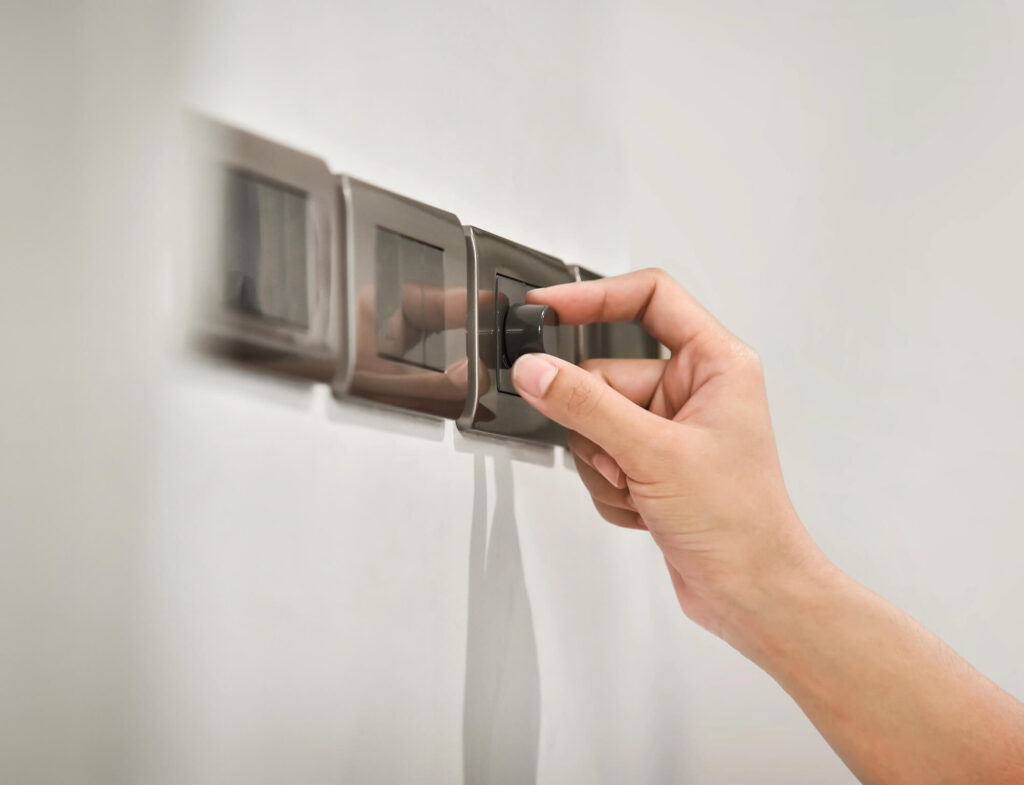
Installing a dimmer switch is one of the easiest ways to add ambiance and save energy in any room. Most dimmer switches can be installed in under an hour using basic tools, but there are key compatibility checks to make before you start.
Contents
⚡ Key Takeaways
- Always turn off the circuit breaker and verify power is off before beginning any switch work
- Confirm your bulbs are dimmable LEDs and compatible with the specific dimmer you choose — look for the ENERGY STAR label, which guarantees the bulb has been tested for flicker-free dimming performance
- Check your switch configuration: single-pole dimmers work with one switch; 3-way configurations need a 3-way compatible dimmer
- Most dimmer switches require a neutral wire — check your switch box before purchasing
- A licensed electrician should handle 3-way, 4-way, or smart dimmer installations if wiring is uncertain
Before You Start: Key Checks
Bulb Compatibility
The most critical step before buying a dimmer: verify your bulbs are dimmable. Most modern LEDs are dimmable, but not all are compatible with every dimmer. Check the dimmer manufacturer’s compatibility list (usually on their website) and choose bulbs listed as compatible with your specific model.
Switch Configuration
Determine whether you have a single-pole switch (one switch controls the fixture) or a 3-way switch (two switches control the same fixture). They look identical from the outside — check the back of the existing switch. A single-pole switch has two brass screws; a 3-way has two brass screws and one black “common” screw.
Neutral Wire Requirement
Standard dimmers typically don’t need a neutral wire. However, many smart dimmers and some LED dimmers require a neutral (white wire). Pull the existing switch out of the box and check if there’s a white wire connected to anything. If not, you may need a “no-neutral” compatible smart dimmer.

Tools and Materials Needed
- Dimmer switch (ensure it matches your switch configuration — single-pole or 3-way)
- Flathead and Phillips screwdrivers
- Non-contact voltage tester
- Wire stripper
- Needle-nose pliers
- Electrical tape or wire nuts (usually included)
How to Install a Dimmer Switch (Single-Pole)
- Turn off the circuit breaker for the switch and verify power is off with a non-contact voltage tester
- Remove the cover plate and unscrew the switch from the electrical box
- Pull the switch out carefully and photograph the existing wiring
- Disconnect the wires from the old switch — note which wires are connected to which terminals
- Connect the dimmer’s wires: Most dimmers have two black (or black and red) wires — one connects to each of the two switch wires in the box. The order doesn’t matter for a single-pole switch. If there’s a green ground wire on the dimmer, connect it to the ground wire in the box.
- If there’s a neutral wire requirement (check dimmer instructions), connect the white wire accordingly
- Tuck the wires back and secure the dimmer to the box
- Install the cover plate — most modern dimmers include a screwless plate
- Restore power and test the full dimming range
Installing a 3-Way Dimmer Switch
A 3-way dimmer setup requires one 3-way compatible dimmer and one standard 3-way switch (you cannot use two dimmers on the same 3-way circuit). The key difference is identifying the “common” wire on the existing 3-way switch — it connects to the black “common” screw. This wire must connect to the corresponding common terminal on the 3-way dimmer. Refer to the dimmer’s specific wiring diagram, as 3-way configurations vary by manufacturer.
Troubleshooting After Installation
- Light flickers at low settings: Adjust the low-end trim pot (small screw on the face of the dimmer) upward until flicker stops
- Light won’t turn fully off: Adjust the low-end trim pot downward
- Humming or buzzing: Usually a bulb compatibility issue — try compatible LEDs listed for your dimmer
- Dimmer feels warm: Normal up to about 30°F above room temperature; if it’s hot to the touch, you may be exceeding the load rating
Frequently Asked Questions
How do I know if my dimmer is single-pole or 3-way?
A single-pole dimmer controls one fixture from one switch location. A 3-way dimmer is used when two switches control the same fixture (like at the top and bottom of a staircase). Check the back of your existing switch — a 3-way switch has three terminals, a single-pole has two.
Do all LED bulbs work with dimmers?
No. Only bulbs labeled “dimmable” can be used with dimmers. Additionally, not all dimmable LEDs are compatible with all dimmers. Check the dimmer manufacturer’s bulb compatibility list for the best results.
My dimmer gets warm — is that normal?
Some warmth is normal — dimmers generate heat as they regulate power. A dimmer that’s too hot to touch for more than a few seconds may be overloaded. Check that the total wattage of connected bulbs doesn’t exceed the dimmer’s rated capacity.
Can I use a regular switch dimmer on a 3-way circuit?
No. Using a single-pole dimmer in a 3-way circuit will cause malfunction. You need a 3-way compatible dimmer (used at one switch location) and a standard 3-way switch at the other location.
Do smart dimmers need a neutral wire?
Most smart dimmers require a neutral wire to maintain standby power for the wireless module. Check the specific product requirements before purchasing. If your switch box has only two wires and no neutral, look for a “no-neutral” smart dimmer model.