
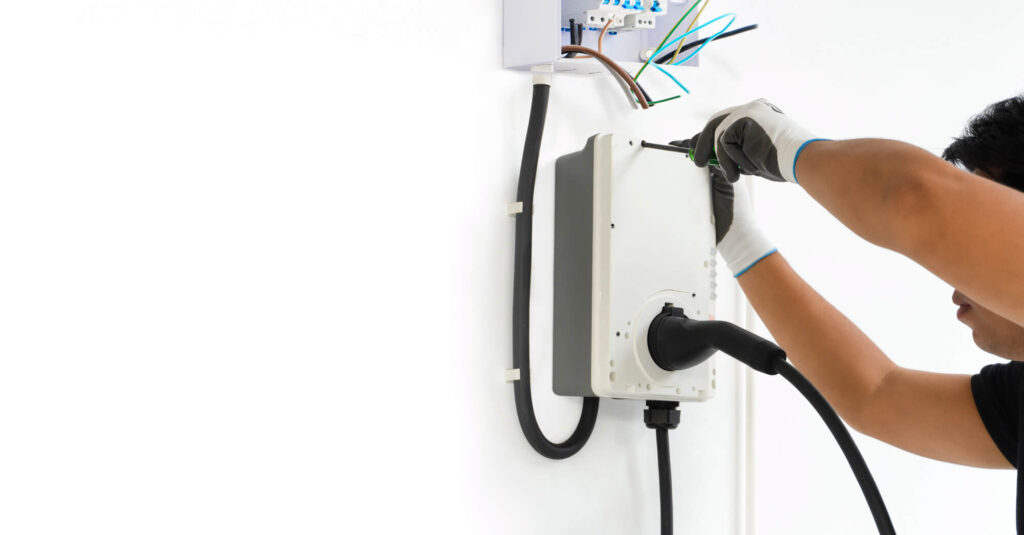
The NEMA 14-50 outlet is the most popular home EV charging solution — a 240V/50A receptacle that works with virtually every portable Level 2 EVSE on the market. Here’s everything you need to know about using a NEMA 14-50 for EV charging.
⚡ Key Takeaways
- A NEMA 14-50 outlet delivers 240V/50A — up to 9.6kW for home EV charging
- Most portable Level 2 EVSE units include a NEMA 14-50 plug, making this the U.S. Department of Energy‘s recommended standard outlet for residential Level 2 EV charging
- Expect 20–30+ miles of range added per hour — a full charge overnight for most EVs
- Installation requires a dedicated 50A circuit with 6-gauge wire and a licensed electrician
- The NEMA 14-50 is the same outlet used for electric ranges — common in many homes
What Is a NEMA 14-50 Outlet?
The NEMA 14-50 is a 240-volt, 50-amp four-prong receptacle. It has two hot terminals (X and Y), a neutral terminal (W), and a ground terminal (G). It’s the standard outlet for electric ranges and is increasingly the go-to outlet for home EV charging because it’s powerful enough to charge most EVs overnight and is compatible with virtually all portable Level 2 chargers.

EV Charging Speed with NEMA 14-50
Connected to a 50A circuit, a Level 2 EVSE draws a maximum of 40A continuous (80% of circuit rating per NEC code), delivering up to 9.6kW. Charging speeds by vehicle:
- Tesla Model 3: ~30 miles per hour (full charge in ~7 hours)
- Chevy Bolt: ~25 miles per hour (full charge in ~7 hours)
- Ford Mustang Mach-E: ~20–22 miles per hour
- Rivian R1T/R1S: ~20–25 miles per hour
- Ford F-150 Lightning: ~20–22 miles per hour (full charge ~11 hours)
Note: actual charging speed is limited by your vehicle’s onboard charger capacity. Some vehicles can only accept 7.2kW regardless of EVSE output.
Which EVSE Units Use NEMA 14-50?
The NEMA 14-50 plug is standard on many portable Level 2 EVSEs, including:
- Tesla Mobile Connector (with the 14-50 adapter)
- JuiceBox 40 and 48 (portable versions)
- ChargePoint Flex (portable mode)
- Lectron Level 2 chargers
- Most 3rd-party portable EVSEs sold for home use
Hardwired chargers (like Tesla Wall Connector, ChargePoint Home Flex hardwired) connect directly to the circuit without a plug — these may offer faster speeds but lack the portability of plug-in units.
Installing a NEMA 14-50 Circuit
A NEMA 14-50 requires a dedicated 240V/50A circuit:
- Wire gauge: 6 AWG copper (4 conductors: 2 hot, 1 neutral, 1 ground)
- Breaker: 50A double-pole circuit breaker
- Outlet box: Weatherproof if outdoor; standard metal or plastic box if indoor/garage
- Conduit: Required for exposed wire runs
Installation must be performed by a licensed electrician with a permit in most jurisdictions. Typical installation cost is $300–$600 for a straightforward garage installation near the panel.
NEMA 14-50 vs. Hardwired Charger
Both approaches are valid. The NEMA 14-50 outlet offers portability — you can take the EVSE with you when you move. A hardwired installation is cleaner, potentially supports higher charging speeds, and may be preferred by some charger manufacturers. For most homeowners, a NEMA 14-50 provides all the speed needed at a lower installation cost with more flexibility.
Safety Considerations
A NEMA 14-50 circuit carries significant power. Key safety points:
- The outlet and circuit must be dedicated to EV charging — no other loads
- The outlet must be GFCI protected in garage locations per NEC code
- Inspect the outlet periodically — 40A continuous loads can cause wear in poorly-made outlets. Use a commercial-grade NEMA 14-50 receptacle rated for continuous duty
- Keep the charging area dry and free of combustibles
NEMA 14-50 vs Hardwired EV Charger: Which Is Better?
NEMA 14-50 outlets and hardwired Level 2 chargers are both effective 240-volt EV charging solutions, but they have important trade-offs. A NEMA 14-50 outlet provides flexibility—you can purchase a portable or pedestal-mounted charger with a 14-50 plug and move it between locations or take it with you if you relocate. This flexibility comes with a small efficiency cost: the connection is slightly less direct than a hardwired installation, and the portable charger hardware itself may be more expensive ($800–$2,500). A hardwired Level 2 charger (such as Tesla Wall Connector, Wallbox, or Leviton) is permanently installed directly to the circuit and mounted on the wall. Hardwired chargers are often 2–5 mph faster at charging because there is no intermediate plug connection, and they offer a cleaner installation with lower maintenance needs. Installation cost is similar ($1,500–$3,000 labor for either approach), but hardwired chargers cost slightly less up front in hardware and have no plug connector to wear out or replace.
Choose NEMA 14-50 if you plan to relocate within 5–10 years or want maximum flexibility; choose hardwired if you’re staying long-term and want the fastest, lowest-maintenance charging experience. If you lease your vehicle, NEMA 14-50 is slightly advantageous because you’re not locked into a specific charger model. For homeowners planning to stay indefinitely and who own their vehicle outright, a hardwired charger is the better long-term investment despite less flexibility. Modern chargers of both types can achieve Level 2 speeds (6–9+ miles per hour added), so the difference in daily charging speed is minimal. Work with a licensed electrician to assess your specific home electrical capacity and location, as panel upgrades ($2,000–$5,000) may be required if you don’t already have available 240-volt capacity.
Frequently Asked Questions
What EVs are compatible with a NEMA 14-50 charger?
Virtually all modern EVs can charge on a NEMA 14-50 outlet using a compatible Level 2 EVSE. This includes Tesla (with adapter), Chevy Bolt, Ford Mustang Mach-E, Rivian, Hyundai Ioniq, BMW, and others. Check your specific vehicle’s onboard charger capacity for maximum charging speed.
How long does it take to charge a Tesla on NEMA 14-50?
A Tesla Model 3 Long Range charges at approximately 30 miles per hour on a NEMA 14-50 circuit, reaching a full charge from empty in about 7–8 hours. Overnight charging easily replenishes a typical daily commute. Model S and X with larger batteries take 9–12 hours for a full charge.
Can I use a NEMA 14-50 outlet for other appliances?
Yes — the NEMA 14-50 is the same outlet used for electric ranges. However, a circuit dedicated to EV charging should not be shared with other major appliances. Install a separate NEMA 14-50 outlet for your range rather than sharing a circuit with EV charging.
Does a NEMA 14-50 need GFCI protection?
In garages, the NEC requires GFCI protection for 240V outlets in many configurations. A licensed electrician will advise on the specific requirement for your installation. Some newer EV-rated GFCI breakers are available that provide both overcurrent and ground-fault protection for EV circuits.
What is the difference between NEMA 14-50 and NEMA 6-50?
The NEMA 14-50 has four prongs: two hots, a neutral, and a ground. The NEMA 6-50 has three prongs: two hots and a ground (no neutral). Most portable Level 2 EVSEs use NEMA 14-50, making it the more versatile choice for home EV charging.