
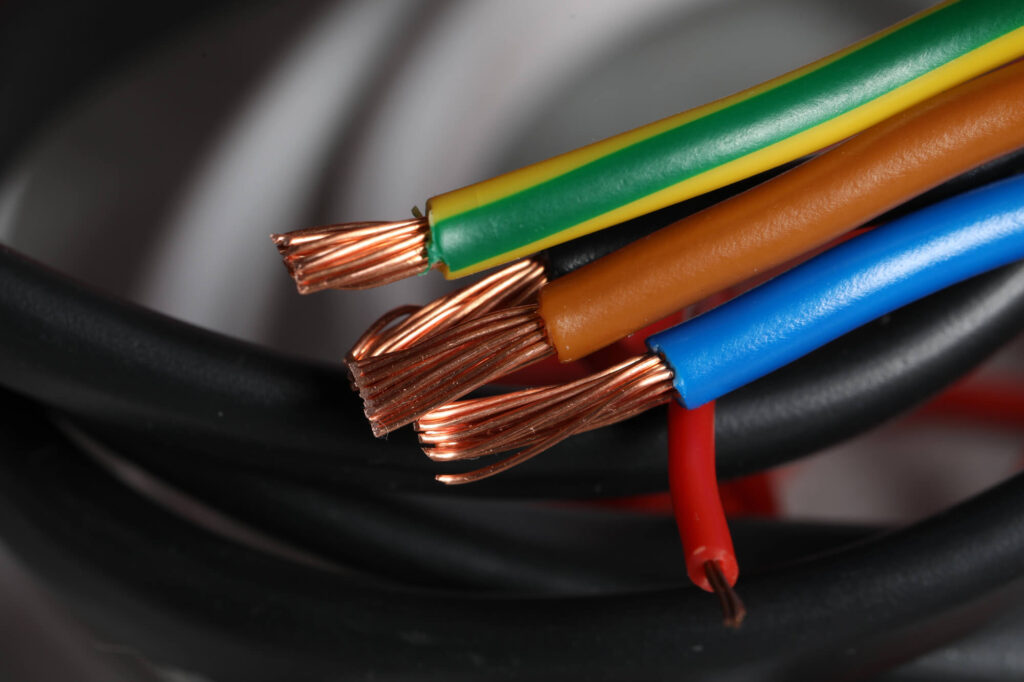
Opening an electrical box and finding a mix of red, black, white, and bare copper wires is confusing if you don’t know what each colour means. Wire colour coding is a safety system — get it wrong and the consequences range from a non-working circuit to a serious shock or fire hazard. This guide covers every wire colour in both US and UK wiring.
⚡ Key Takeaways
- In US wiring: black = hot, white = neutral, bare copper/green = ground, red = second hot.
- In modern UK wiring (post-2004): brown = live, blue = neutral, green/yellow = earth.
- In old UK wiring (pre-2004): red = live, black = neutral — opposite to US convention.
- Always test with a voltage tester before touching any wire — colour coding can be incorrectly applied.
US Electrical Wire Colour Guide
US National Electrical Code (NEC) colour conventions for standard NM (Romex) cable:
- Black: Hot (live). Always connects to brass-coloured screws on outlets and switches.
- White: Neutral. Connects to silver-coloured screws. May be used as a hot conductor in switch loops (must be marked with black tape at both ends in modern wiring).
- Bare copper or green: Ground (earth). Connects to the green screw. Does not normally carry current during operation.
- Red: Second hot conductor. Used in 240V circuits (alongside black), 3-way switch traveller wires, and smoke detector signalling. Always live.
- Blue, yellow: Hot conductors used in specific applications — traveller wires in switch loops, hot conductors in conduit wiring. Always treat as potentially live.
UK Electrical Wire Colour Guide (Modern — Post-2004)
UK wiring adopted harmonised European colours in 2004:
- Brown: Live (equivalent to US black)
- Blue: Neutral (equivalent to US white)
- Green with yellow stripe: Earth (equivalent to US bare copper or green)
For 3-core cable (used in two-way switching): brown = permanent live, grey = switched live, black = neutral conductor (not the same as old black = neutral).
UK Electrical Wire Colour Guide (Old — Pre-2004)
Older UK wiring uses a completely different scheme:
- Red: Live (this was the standard live in all pre-2004 UK wiring)
- Black: Neutral (note: this is opposite to US convention)
- Green with yellow stripe: Earth (unchanged)
Mixed old/new wiring in the same property requires particular care. An old black wire is neutral; a new blue wire is neutral. But an old black wire and a new blue wire are NOT directly equivalent in a 3-way switch context — the functions can differ.
For More Detail on Specific Wire Functions
For a detailed explanation of what each wire type does, see: what the neutral wire does, what the red wire is, and which wire is hot — black or white.
Confused about wiring in your home? Our qualified electricians can identify and safely label any wiring.
Full Household Wiring Colour Code Explained
- Black: Hot conductor — phase 1 in a standard 120V circuit. Always treat as live.
- Red: Hot conductor — phase 2 in 240V circuits, or traveler/switch leg in control wiring.
- White: Neutral conductor — returns current to the source. Can be used as a hot conductor when re-identified with black tape.
- Bare copper (no insulation): Equipment grounding conductor — protective ground path. Should not carry current under normal conditions.
- Green (or green with yellow stripes): Equipment grounding conductor — same function as bare copper but insulated. Common in conduit wiring.
- Blue/yellow: Used as phase conductors in conduit systems (not standard in residential cable). Always verify with a voltage tester.
Practical Safety Rules for Working with Wires
- Always turn off the circuit breaker before working on any wiring
- Always verify the wire is de-energized with a non-contact voltage tester before touching it
- Treat any unidentified wire as live until proven otherwise
- In older homes, the colour coding may not match modern standards — trace wires before assuming
- In junction boxes, never disconnect wires before photographing or labelling them
UK vs. US Colour Codes: Key Differences
Confusion between UK and US colour codes is a serious safety risk. In the UK (post-2004): brown = live, blue = neutral, green/yellow = earth. A UK blue wire is neutral — but in the US, a blue wire may be a hot conductor. If you’re working on wiring with unknown origin (imported fixtures or appliances), verify with an electrician rather than assuming standard colour coding applies.
What to Do When You Find Wires You Don’t Recognise
If you open an electrical box and find wires where the colour coding seems inconsistent or unfamiliar, stop work and call a licensed electrician. An unidentified wire could be a second hot leg in a 240V circuit, a switch leg, or an interconnect wire — each with different implications. Working on an unidentified wire is one of the leading causes of DIY electrical injuries. A professional will trace the circuit properly and mark wires clearly before any work continues.
Wire Color Standards and Why They Matter for DIY Awareness
Understanding wire color standards in household electrical systems is critical for DIY enthusiasts, homeowners, and anyone working near electrical panels. The standardized color coding system used in the United States follows the National Electrical Code (NEC) guidelines, which are enforced by local electrical inspectors and insurance underwriters. The white (neutral) wire, black (hot) wire, and red (hot on 240V circuits) wire system has been in place for decades, creating a universal language among electricians nationwide. However, older homes may have different wire colors or even fabric-coated wires without color coding, which adds confusion and risk. When renovating or expanding electrical service in older U.S. homes, electricians must trace wires carefully because previous work may not comply with modern standards. Additionally, in 240-volt circuits common in the U.S. (used for dryers, ranges, and some air conditioning units), both the black and red wires carry voltage, making understanding wire colors even more critical for safety. Homeowners should never attempt to work with wires beyond identifying their purpose—always hire a licensed electrician for any circuit modifications or repairs.
Frequently Asked Questions
What does a white wire with black tape mean?
In US wiring, a white wire marked with black tape has been re-identified as a hot (live) conductor. This is done when a white wire is used as a hot in a switch loop or other application where a coloured wire would be required but only white is available (e.g., in a 2-conductor cable). The tape or paint indicates it should be treated as a hot wire, not a neutral.
What happens if you connect wires to the wrong terminals?
Reversing hot and neutral (connecting black to silver screw, white to brass screw) creates a ‘reverse polarity’ condition. The device may still work, but the metallic shell of a light bulb or the outer contact of a socket becomes live — a shock hazard. Connecting the ground to a live terminal can energise the enclosure, creating a potentially fatal hazard.
Are wire colour codes legally binding?
In the US, the NEC specifies colour coding for certain conductors but allows flexibility in others. In the UK, BS 7671 specifies the harmonised colours for post-2004 work. Electricians are required to follow these standards. For homeowners doing their own work, following the colour code is both a legal requirement (where applicable) and a critical safety practice.