
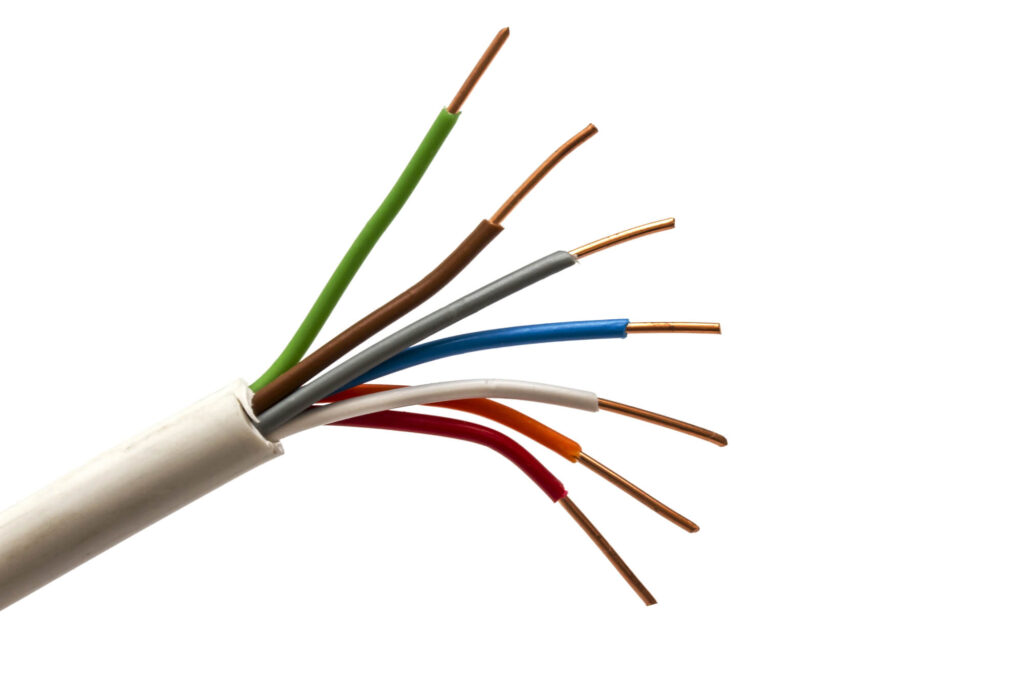
If you’ve opened an outlet or looked inside an electrical panel, you may have noticed wires in different colours — black, white, red, and green. Each colour has a specific meaning in electrical wiring. This guide explains what the red wire does and when you’ll encounter it in your home.
⚡ Key Takeaways
- Red wires are secondary hot wires used in circuits with more than one hot conductor.
- Red wires are commonly found in 3-way switches, 240V circuits, and breaker panels.
- Red wires carry live electrical current and must be treated as hazardous.
Wire Colour Codes in Electrical Systems
Electrical codes standardise wire colours to make it clear which wires carry power and which do not. Black = hot (live), red = secondary hot, white or grey = neutral, and green or bare copper = ground. This system ensures that any qualified electrician can instantly understand the wiring in a home, reducing the risk of mistakes.
What Does a Red Wire Do?
A red wire is a secondary hot wire. It carries live electrical current, just like a black wire, but in circuits where multiple hot conductors are needed. You will not see red wires in simple single-pole circuits (like a standard light switch controlling one light). Red wires appear in more complex configurations.
Where Red Wires Are Commonly Used
3-Way and 4-Way Switches
A 3-way switch setup (lights controlled from two locations) requires two hot wires: one to start the circuit and one to complete it based on the switch position. The red wire is often the second hot wire in these setups. See our guide on how to wire a 3-way switch.
240V Circuits
In a 240V appliance circuit (for ovens, dryers, water heaters), two hot wires are needed — often black and red. The red wire carries the second 120V phase, which combines with the black wire to deliver 240V to the appliance.
Breaker Panels with Multiple Hots
Some breaker configurations require red wires to connect multiple live conductors. Red wires in a panel are always live and should only be worked with by a qualified electrician.

Red Wires in Older Wiring Systems
In the UK before 2004, wiring colour codes were different: red insulation for live, black for neutral, and green for ground. Modern wiring uses brown for live, blue for neutral, and green/yellow striped for ground. If you see old red wiring in your home, it may be dated wiring that should be checked by an electrician as part of an electrical safety inspection.
Safety Warnings with Red Wires
Red wires carry live electrical current and must always be treated as hazardous. Never touch a red wire in a live circuit — the risk of electrical shock is the same as with black wires. If you see a red wire where you expect a neutral or ground, stop and contact a qualified electrician immediately. A misplaced red wire could indicate a wiring error or dangerous configuration.
Red Wire Uses in 240V Circuits
In 240V circuits, the red wire is the second hot wire. Two-phase residential circuits (like those powering electric ranges, water heaters, and air conditioners) require two separate hot wires to generate 240V. One is black (first hot), the other is red (second hot). Both carry full voltage and both are live at all times — never assume a red wire is neutral or ground. The circuit breaker that serves a 240V appliance will typically have two breaker switches, one controlling black, one controlling red. Both must be switched off to safely work on a 240V circuit.
Red Wire in 3-Way Switch Wiring
Three-way switches — allowing you to control a light from two different locations — use a red wire as a traveller wire. In a 3-way installation, two black (or one black and one red) wires run between the switch locations to carry the switching control signal. The red wire in this context is not a second hot wire; it’s part of the control circuit and should never carry full voltage on its own. If you see red wiring in a switch loop, verify the circuit function before touching anything.
Red Wire Safety Rules
Treat all red wires as live and potentially dangerous unless the breaker controlling the circuit is switched off and verified with a multimeter. Red wires are never neutral or ground. Do not trace a red wire without knowing which breaker controls it. In a 240V application with a single circuit breaker with two switch handles, you must switch both sides off. A red wire that’s de-energized in one application might be live in another — context and verification are essential.
UK vs US Colour Differences
The UK adopted new wiring colours in 2004 to align with European standards. In older UK installations (pre-2004), red indicated a live wire. In modern UK wiring (post-2004), brown is live and red is not used at all in standard circuits. In the US, red wire standards have remained consistent and are used as described above. If you’re working in a property with mixed wiring ages (renovation, new addition), verify colour codes before assuming any wire’s function. Always use a multimeter in addition to colour coding.
Red Wires in Industrial and Commercial Applications
While residential homes use red wires primarily for three-way or four-way switches, commercial and industrial electrical systems employ red wires more extensively. In three-phase power systems, red is typically the second hot conductor (following black as the first hot and sometimes blue as the third hot conductor). In commercial buildings, red might indicate a higher voltage circuit or a circuit serving a specific area or function, depending on the facility’s electrical plan.
Industrial machinery and control systems often use different color coding conventions entirely. Some equipment uses red to indicate emergency stop circuits, power feeds to critical systems, or circuits requiring special attention during maintenance. The color coding can vary significantly between manufacturers and industries, which is why electricians working on specialized equipment must always consult the equipment’s specific wiring diagram and documentation.
In data centers and telecommunications facilities, red wiring sometimes indicates power circuits as opposed to signal or control lines, which might be color-coded differently. Understanding the context and consulting the facility’s electrical one-line diagram is essential for any work involving colored conductors beyond the standard residential black/white/green scheme. When in doubt, a licensed electrician can review the system’s documentation and use a voltmeter to identify circuit functions safely.
Frequently Asked Questions
Is a red wire always hot?
Yes. A red wire in a properly installed circuit is always a live (hot) conductor and must be treated as dangerous. However, in some older or non-standard installations, red may be misused. When in doubt, test a red wire with a non-contact voltage detector before assuming it is safe.
Can I use a red wire as a neutral?
No. Reusing a red wire as a neutral is against electrical code and creates a serious hazard. Always use the correct wire colour for the intended purpose.
Why do 3-way switches need a red wire?
A 3-way switch needs two hot wires to form two different current paths, depending on switch position. One path uses the black wire, the other uses the red wire. This allows the light to be controlled from either location.