
Charging an EV in an apartment or condo presents unique challenges — you don’t control the electrical infrastructure, and landlord or HOA approval is often required. But thanks to new laws and practical workarounds, EV charging in multi-unit housing is increasingly achievable.
Contents
⚡ Key Takeaways
- Many states have “right to charge” laws requiring landlords and HOAs to allow EV charger installation
- Level 1 charging from a standard 120V outlet is often the simplest starting point for apartment renters
- Dedicated Level 2 charger installation requires landlord permission and a licensed electrician
- Some apartment complexes are installing shared EV charging stations — ask your property manager
- The federal EV charger tax credit can apply to qualifying multi-unit installations
Right-to-Charge Laws
A growing number of states have enacted “right to charge” legislation that prevents landlords and HOAs from unreasonably prohibiting EV charger installation. As of [year], states with right-to-charge laws include California, Colorado, Florida, Hawaii, Oregon, Virginia, and others. The U.S. Alternative Fuels Data Center (AFDC) maintains a full, up-to-date list of EV charging laws and incentives by state. These laws vary — some require only that landlords cannot unreasonably deny a request; others specify approval timelines and cost-sharing rules.
Even without a state law, many landlords will agree to EV charger installation if the tenant covers all costs, uses a licensed electrician, obtains permits, and returns the parking space to its original condition upon move-out.

EV Charging Options for Apartment Renters
Option 1: Level 1 Charging (120V)
If your parking space is near an outdoor outlet or your garage has a standard outlet, Level 1 charging (3–5 miles/hour) may be all you need. Check whether the outlet is on your unit’s electricity meter or a shared circuit. If it’s shared, work with your landlord to arrange billing.
Option 2: Dedicated Level 2 Charger in Your Space
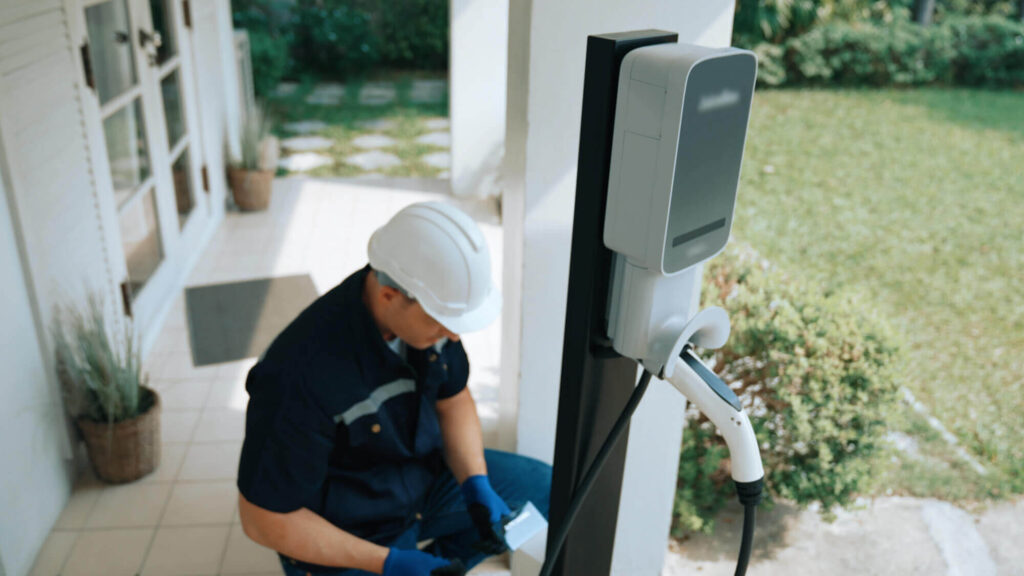
With landlord approval, a licensed electrician can install a dedicated 240V circuit and Level 2 charger in your assigned parking space. You’ll pay for installation, and the charger can be configured to bill back to your electricity account. Some renters use smart chargers that track usage for reimbursement purposes.
Many apartment complexes are installing shared EV charging stations — either through commercial charging networks (ChargePoint, Blink) or building-owned equipment. Ask your property manager whether this is available or planned. If not, you can present a proposal; many properties welcome tenant-funded charging infrastructure upgrades.
Option 4: Public Charging
For renters without home charging options, workplace charging, public Level 2 stations, and DC fast chargers provide alternatives. Apps like PlugShare, ChargePoint, and EVgo can locate nearby charging stations. This is less convenient than home charging but workable for occasional use.
EV Charging in Condos and HOAs
Condo owners (as opposed to renters) have more leverage — they own their unit and often have exclusive use of a parking space. Even so, common area electrical infrastructure is typically HOA-managed. Steps to take:
- Review your HOA CC&Rs — many have been updated to accommodate right-to-charge laws
- Submit a formal request to the HOA board with a proposal from a licensed electrician
- Propose a sub-meter or smart charger to ensure accurate billing for your electricity use
- Reference your state’s right-to-charge law if applicable
Installation Considerations for Multi-Unit Buildings
Multi-unit EV charger installations have additional complexity beyond single-family homes:
- Electrical capacity: The building’s electrical service must support additional EV loads — a licensed electrician will assess this
- Load management: Smart chargers with load-balancing capabilities prevent overloading the building’s service
- Metering: Individual sub-meters or smart charger billing features ensure tenants pay only for their own charging
- Permitting: Multi-unit installations may require commercial permits in addition to standard electrical permits
Frequently Asked Questions
Can my landlord refuse to let me install an EV charger?
It depends on your state. Many states have right-to-charge laws that prevent landlords from unreasonably denying EV charger requests. Even without a state law, many landlords will agree if the tenant covers all costs and uses a licensed electrician. Check your state’s specific laws and your lease agreement.
Can I charge my EV using a regular outlet at my apartment?
Yes, if you have access to a standard 120V outlet near your parking space. Level 1 charging adds 3–5 miles per hour — sufficient for many daily drivers. Check whether the outlet is on your unit’s meter or a shared circuit, and arrange billing with your landlord if needed.
Who pays for EV charger installation in an apartment building?
Typically the tenant or unit owner requesting the charger pays for installation. In some cases, landlords may subsidize installation as a property improvement. HOAs may allow assessment of costs to the requesting unit owner. Utility and government rebate programs can offset a significant portion of the cost.
What is a smart EV charger and why is it useful in apartments?
Smart chargers connect to Wi-Fi and can track charging sessions, schedule charging for off-peak hours, and bill usage to specific accounts. In multi-unit buildings, this enables accurate billing for electricity used by individual EV owners sharing building electrical infrastructure.
What is load management for EV chargers?
Load management (or load balancing) coordinates multiple EV chargers on the same electrical circuit so they don’t exceed the building’s service capacity. When multiple cars charge simultaneously, the system distributes available power between them, preventing circuit overloads without requiring costly electrical upgrades.