
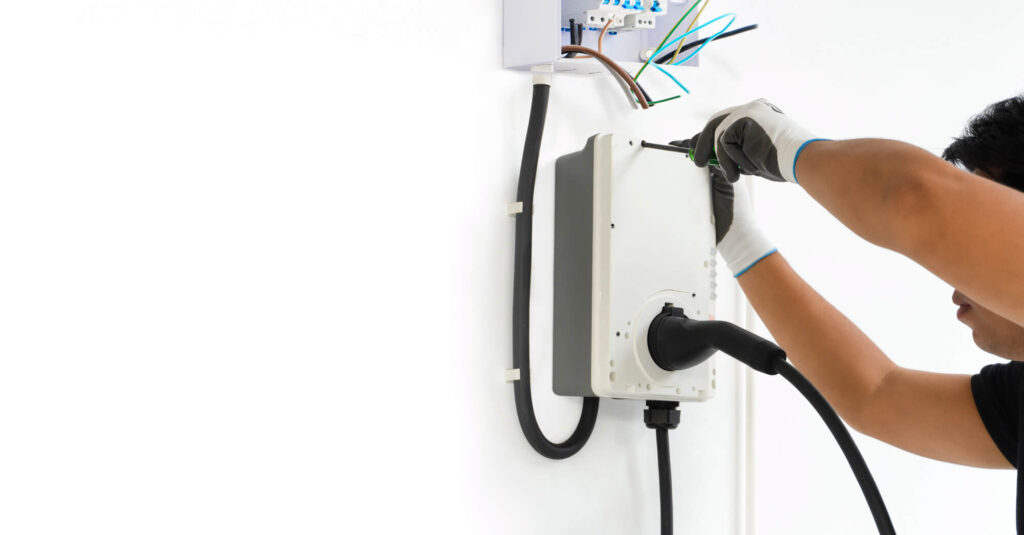
The cost to install a Level 2 EV charger at home is one of the most common questions from electric vehicle owners. A Level 2 charger delivers up to 10 times faster charging than a standard 120V outlet — the U.S. Department of Energy recommends Level 2 as the standard for home EV charging. This guide covers typical installation costs, what affects pricing, and what to expect from the installation process.
Contents
⚡ Key Takeaways
- A Level 2 charger operates on 240V power — the same voltage as your electric dryer or range — and can add 20–30 miles of range per hour of charging, depending on your vehicle and charger output.
- The total installed cost depends on the charger hardware, the distance from your panel, and whether a new circuit or panel upgrade is required:
- Distance from Electrical Panel The further the charger is from your main panel, the more wiring is required.
What Is a Level 2 EV Charger?
A Level 2 charger operates on 240V power — the same voltage as your electric dryer or range — and can add 20–30 miles of range per hour of charging, depending on your vehicle and charger output. This compares to just 3–5 miles per hour from a standard 120V outlet. For most EV owners, a Level 2 home charger means waking up to a full battery every morning regardless of how much driving was done the day before.
Average Cost to Install a Level 2 EV Charger
The total installed cost depends on the charger hardware, the distance from your panel, and whether a new circuit or panel upgrade is required:
- Level 2 charger hardware (EVSE unit): $300 – $800 for a quality residential unit
- Electrician installation labor: $300 – $1,000 depending on complexity
- New 240V, 50-amp circuit from panel: Included in most quotes or $300 – $700 if a significant wiring run is required
- Permit fees: $50 – $200 in most jurisdictions
- Panel upgrade if needed: $1,500 – $3,500 additional
- Typical total installed cost (no panel upgrade): $700 – $2,000
Factors That Affect Installation Cost
Distance from Electrical Panel
The further the charger is from your main panel, the more wiring is required. A garage adjacent to the panel is cheapest. A detached garage or charging location on the far side of the home adds cost for longer conduit and cable runs.
Panel Capacity
A Level 2 charger requires a dedicated 240V circuit — typically 50 amps for a 48-amp charger. If your panel is full or lacks available capacity, a panel upgrade or sub-panel may be required, adding to the overall cost.
Conduit and Outdoor Wiring
If the charger is mounted outdoors or the cable must run through conduit, materials cost increases. Exterior-rated conduit and weatherproof outlet covers are required for outdoor installations.

Choosing the Right Level 2 Charger
Key specifications to consider when selecting a Level 2 EVSE:
- Amperage output: 32-amp units charge at a moderate rate; 48-amp units are faster and future-proof for higher-capacity EVs
- Smart features: Wi-Fi connectivity, scheduling, and energy monitoring allow you to charge during off-peak utility rates
- Cord length: 18–25 foot cords accommodate most garage layouts without needing to reposition the vehicle
- Brand compatibility: Most Level 2 chargers use the SAE J1772 connector, which is compatible with all non-Tesla EVs. Tesla owners can use an adapter or purchase a Tesla-compatible unit
Get an accurate cost estimate before you commit. Our EV installation team provides transparent quotes with no surprises — contact us today.
Federal Tax Credit for EV Charger Installation
The Alternative Fuel Vehicle Refueling Property Credit (IRS Form 8911) provides a federal tax credit of up to 30% of the cost to install a Level 2 EV charger at your home, up to $1,000. Consult your tax advisor to confirm eligibility based on your specific situation.
Frequently Asked Questions
Do I need a permit to install a Level 2 charger?
Yes, in most jurisdictions. EV charger installation requires a permit and electrical inspection because it involves a new 240V circuit. Your licensed electrician will handle permit procurement as part of the installation.
Can I install a Level 2 charger myself?
The electrical work — running a new 240V circuit and connecting the charger — must be performed by a licensed electrician in most areas. Mounting the charger unit itself after the circuit is installed is straightforward, but the circuit work requires a professional.
How long does Level 2 charger installation take?
Most installations take 2–4 hours for the electrical work. Permit processing may add days to the timeline. Complex installs requiring conduit runs or sub-panel work can take a full day.
What amperage Level 2 charger should I get?
A 48-amp charger is the best long-term investment — it provides the fastest charging available to most home EVs and is compatible with next-generation high-capacity vehicles. A 32-amp unit is adequate for most current EVs if cost is a concern.