
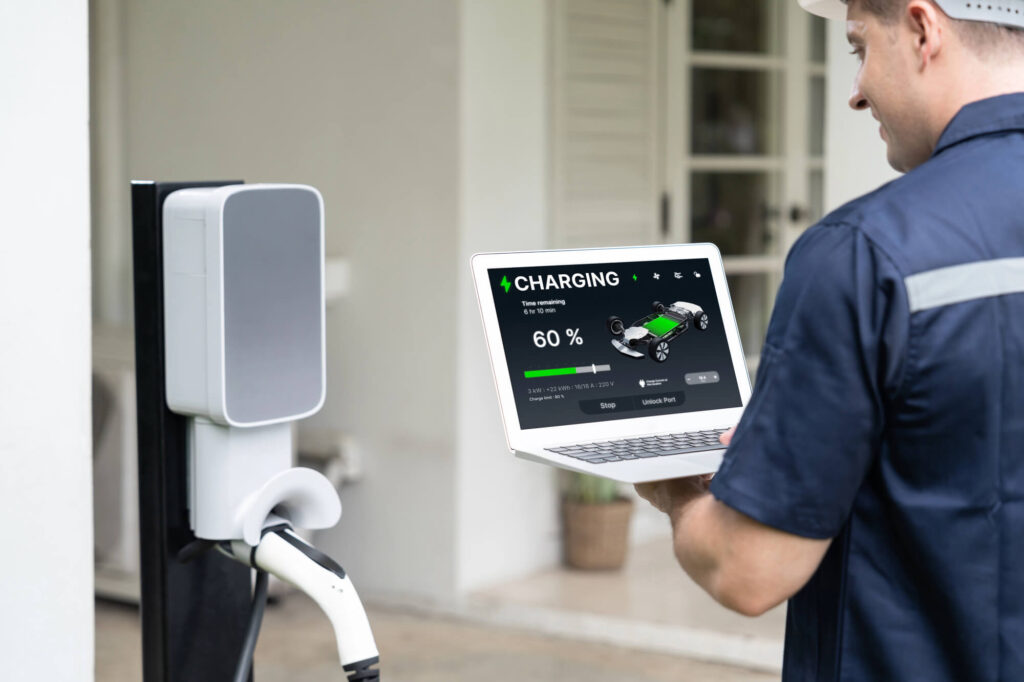
The cost to install an EV charger at home depends on the type of charger, the complexity of the electrical work, and whether your panel has sufficient capacity. For most electric vehicle owners, a home EV charger is the most convenient and cost-effective way to charge — eliminating range anxiety and ensuring your vehicle is ready every morning. This guide covers all-in costs, key variables, and what the installation process looks like.
Contents
⚡ Key Takeaways
- There are two practical home charging options for most EV owners:
- EV charger hardware (EVSE unit): $300 – $800 for a residential Level 2 unit Electrician installation labor: $300 – $1,000 240V circuit and wiring (if new run needed): Included in most quotes, or $300 – $700 for longer runs Permit and inspection fees: $50 – $200 Total installed cost (charger + installation): $700 – $2,000 for most standard installations If your panel requires an upgrade or a new sub-panel to accommodate the EV circuit, add $1,500 – $3,500 to the above.
- Panel Capacity and Available Breaker Slots A Level 2 charger requires a dedicated 240V circuit — typically 40–60 amps.
Types of Home EV Chargers and Their Costs
There are two practical home charging options for most EV owners:
- Level 1 (120V): No installation cost — simply plug into an existing outlet. Adds 3–5 miles of range per hour. Only suitable for plug-in hybrids or EV owners with very low daily mileage.
- Level 2 (240V): Requires a licensed electrician to install a dedicated 240V circuit. Adds 20–30+ miles of range per hour. The standard for any EV with more than 30 miles of daily driving.
This guide focuses on Level 2 installation, which is what the vast majority of EV owners need.
Average Cost to Install an EV Charger at Home
- EV charger hardware (EVSE unit): $300 – $800 for a residential Level 2 unit
- Electrician installation labor: $300 – $1,000
- 240V circuit and wiring (if new run needed): Included in most quotes, or $300 – $700 for longer runs
- Permit and inspection fees: $50 – $200
- Total installed cost (charger + installation): $700 – $2,000 for most standard installations
If your panel requires an upgrade or a new sub-panel to accommodate the EV circuit, add $1,500 – $3,500 to the above.
What Affects EV Charger Installation Cost
Panel Capacity and Available Breaker Slots
A Level 2 charger requires a dedicated 240V circuit — typically 40–60 amps. If your panel is full or near its capacity limit, an upgrade or sub-panel may be needed before the charger can be installed. An electrician assesses this during a pre-installation assessment.
Distance from Panel to Charger Location
The further the charger location from the main panel, the more conduit and cable is needed — increasing material and labor costs. A garage adjacent to the panel is the simplest scenario. A detached garage or exterior charging location adds complexity.
Conduit and Exterior Wiring
Outdoor wiring and longer conduit runs through finished walls require more labor and materials than direct connections in open garages. Weatherproof enclosures and appropriate cable types are required for exterior installations.
Federal Tax Credit for EV Charger Installation
The IRS Alternative Fuel Vehicle Refueling Property Credit (Form 8911) provides a 30% tax credit on EV charger installation costs, up to $1,000 for residential installations. This applies to labor and permit costs, not typically the hardware itself. Check with your tax advisor to confirm current eligibility requirements.
Utility Rebates for EV Charger Installation
Many utility companies offer rebates of $100 – $500 for installing a Level 2 EV charger at home. Some utilities also offer time-of-use rate plans that significantly reduce charging costs when charging overnight during off-peak hours. Check your utility’s website for current EV programs in your area.
Understanding the full cost of EV charger installation helps you plan ahead. Contact our EV team for a detailed quote that covers labor, materials, and any needed panel work.
Frequently Asked Questions
Can I install an EV charger in a rented home?
Tenants can request EV charger installation from their landlord. In many states, landlords are required to permit reasonable EV charging accommodations. The charger installation itself still requires a licensed electrician and landlord coordination.
How long does home EV charger installation take?
Most standard installations take 2–4 hours. More complex projects involving panel upgrades or long conduit runs can take a full day. Permit processing typically adds days to the overall timeline.
What is the cheapest way to charge an EV at home?
The most cost-effective home charging setup is a Level 2 charger on a time-of-use utility rate plan, charging overnight during off-peak hours. In most areas, this reduces per-mile charging costs to the equivalent of paying under $1.50 per gallon of gasoline.
Does every EV use the same charging connector?
Almost all non-Tesla EVs use the SAE J1772 connector for Level 2 charging. Tesla vehicles use a proprietary connector but come with a J1772 adapter. Starting with some 2025 model year vehicles, Tesla has adopted the NACS connector, which is also being adopted by other manufacturers.